
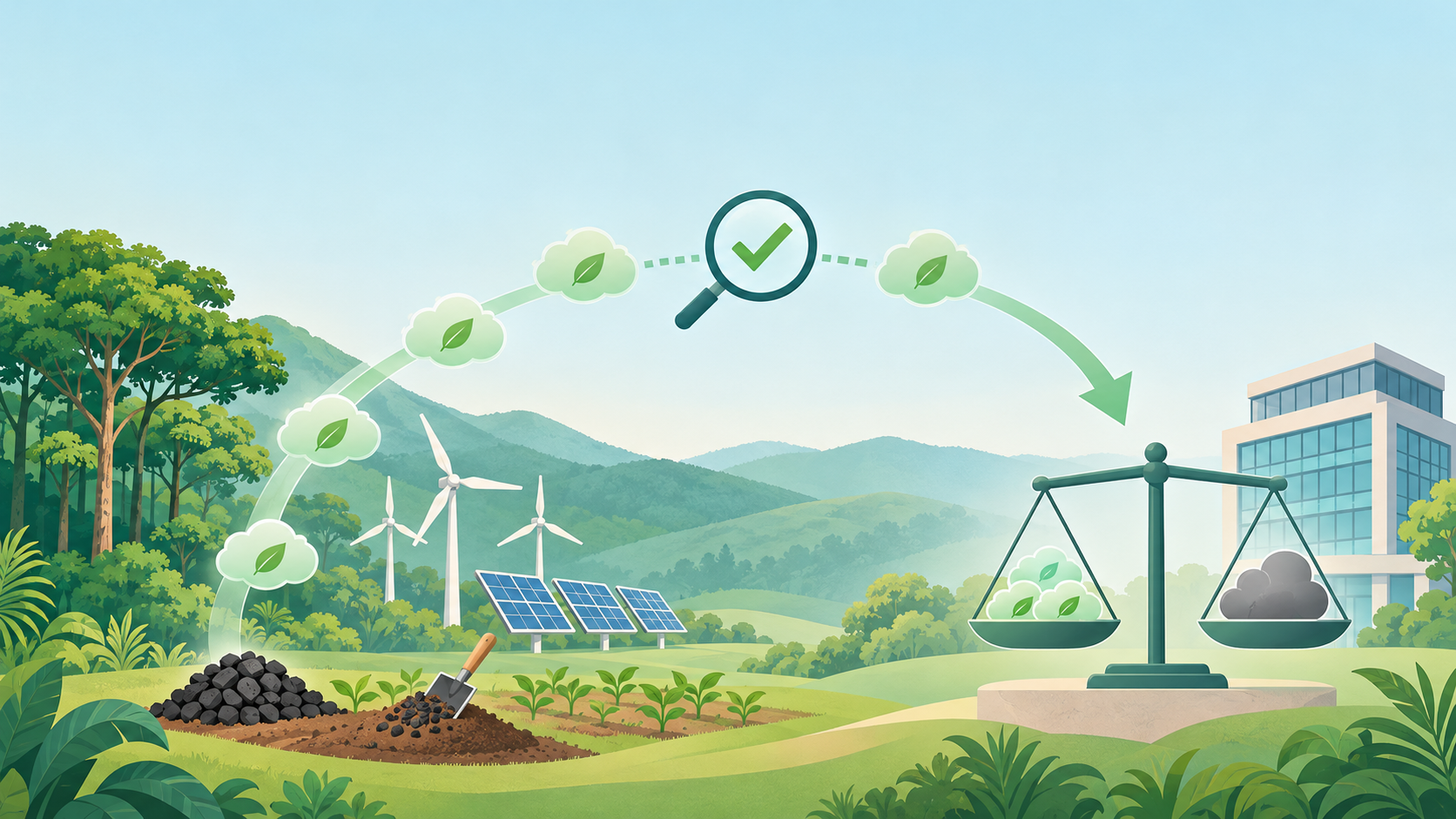
Many companies are working to reduce greenhouse gas emissions to achieve a decarbonized society. Carbon credits are a mechanism that makes the amount of emissions reduced or greenhouse gases absorbed by companies and organizations tradable, supporting the achievement of decarbonization targets 1, 2, 3.
These credits typically correspond to a reduction or absorption of 1 ton of carbon dioxide emissions 1, 2. Even if a company finds it difficult to reduce its own emissions, purchasing carbon credits allows it to offset those emissions 1, 2.
This article provides a clear explanation of carbon credits, from their basic mechanism to types and important points to consider when using them.
Basic Mechanism of Carbon Credits
Carbon credits are a certification of the amount of greenhouse gases reduced or absorbed by companies and organizations through activities like forest protection or the introduction of energy-saving equipment, made tradable as "credits" 1, 2, 3. This certifies greenhouse gas (GHG) emission reductions or absorptions, in terms of 1 ton of CO2 equivalent per credit, making them tradable 1, 2, 3.
One carbon credit typically corresponds to a reduction or absorption of 1 ton of CO2 emissions 1, 2. This mechanism allows companies that struggle to meet their greenhouse gas reduction targets to purchase amounts reduced by other companies, thereby offsetting their own emissions 1, 2. This helps companies achieve their emission targets 1, 2.
Types of Carbon Credit Markets: Compliance and Voluntary Credits
Carbon credits are broadly divided into two types based on their operating body: "compliance credits" led by the UN or governments, and "voluntary credits" led by private organizations 4, 3, 5, 6. This distinction also relates to their usage and market characteristics 4, 3.
In Japan, a representative example of compliance credits is "J-Credits" 4. These are operated under the leadership of the Japanese government and local public bodies 4.
On the other hand, voluntary credits are certified and issued by private companies, NGOs, and similar entities 5, 6, 7. A key feature is their flexibility in use, as they are not bound by national or regional regulations 5, 6, 7.
International voluntary credit certification schemes include VCS (Verified Carbon Standard) and Gold Standard 5, 6, 7.
Types of Carbon Credits: Reduction/Avoidance and Removal/Absorption
Carbon credits are categorized into two types: "avoidance/reduction credits" which prevent future emissions, and "removal/absorption credits" which directly capture CO2 from the atmosphere 8, 4, 2.
Avoidance/reduction credits are generated from activities that reduce greenhouse gas emissions, such as the introduction of renewable energy or energy efficiency improvements 4, 2.
Removal/absorption credits are created through activities that physically remove CO2 from the atmosphere, such as afforestation and forest management, biochar, and Direct Air Capture and Carbon Storage (DACCS) 8, 4, 2, 9.
Under the SBTi (Science Based Targets initiative) Net-Zero Standard, only removal credits are accepted for offsetting residual emissions in achieving the final 2050 target 4.
Trends and Market of Carbon Credits in Japan
In Japan, there is a national certification system called the "J-Credit Scheme," which targets greenhouse gas reductions and absorptions from energy saving, renewable energy, and forest management 10, 11, 12. Under this scheme, applications for certification of CO2 absorption by forests through forest management activities and afforestation activities are possible 10, 13.
The domestic carbon credit market in Japan opened at the Tokyo Stock Exchange in October 2023, with trading of J-Credits beginning 10, 4.
Furthermore, partial mandatory implementation of the Domestic Emission Trading Scheme (GX-ETS) is scheduled to start in April 2026, where J-Credits and JCM will be available as offsetting tools 2.
Significance of Carbon Credit Utilization and Precautions for Use
Carbon credits are drawing attention as an economic tool for achieving carbon neutrality 1. Those who generate them can use the proceeds from sales to invest in further emission reductions 3.
When companies use them, it is crucial to first thoroughly reduce their own emissions and then position carbon credits as a means to supplement any remaining unavoidable emissions 4.
If the quality of credits is low, companies face the risk of being criticized for "greenwashing" (superficial environmental consideration) 4. Additionally, "double counting" is another issue in their use 4. This refers to cases where credits are issued multiple times from a single reduction activity, the same credit is used multiple times, or the same reduction amount is claimed for achieving multiple targets 14.
To choose high-quality credits, it is recommended to check the following criteria:
- Additionality
- Permanence
- Prevention of double counting
- Reliability of Measurement, Reporting, and Verification (MRV)
Conclusion
Carbon credits are an effective means to achieve a decarbonized society, but it is crucial to understand their mechanisms and types, assess their quality, and use them appropriately. By selecting reliable credits, companies can avoid the risk of being criticized for "greenwashing"—promoting environmental consideration without substance—and contribute to effective decarbonization management 15.
Our company is interested not only in the utilization of carbon credits but also in environmental conservation activities in the regions where they are created. Please feel free to consult us if you have any challenges with decarbonization management.