

Category: Sustainable Agricultural Trade

  • How Green Coffee Beans Are Made: From Red Cherries to Export-Ready Beans

    How Green Coffee Beans Are Made: From Red Cherries to Export-Ready Beans

    Green coffee beans are the seeds taken from the red fruit of the coffee tree, known as the coffee cherry. Between harvest and packing in export bags, there are many steps, including sorting, processing, drying, hulling and grading, and the care taken at each step determines the quality of the green beans.

    This article is for buyers considering sourcing green coffee. It explains, step by step, how red cherries become export-ready green beans, and lists the points to check with producers when evaluating a supplier.

    1. The coffee cherry and the green bean

    A coffee cherry is made up of layers: the outer skin, the sweet pulp, a sticky layer called mucilage, a husk that wraps the seed (the parchment), and a thin silvery skin (the silver skin). The seed at the center is what we call the “coffee bean.” Usually, each fruit contains two seeds facing each other.

    Making green beans is the work of removing the unnecessary parts of the fruit and preparing the seeds for storage and transport.

    2. Harvest: picking only ripe red cherries

    As coffee cherries ripen, their color changes from green to yellow to red. Because cherries on the same branch do not ripen at the same time, producers who focus on quality pick only the fully ripe red cherries by hand.

    When unripe or overripe cherries are mixed in, they cause uneven flavor and defects. How well red cherries are selected at harvest is the first turning point for the quality of the final product.

    3. Sorting: evening out the cherries by flotation and other methods

    Harvested cherries are sorted before processing. A typical method is flotation sorting, in which the cherries are placed in a tank of water. Dense cherries sink, while unripe, insect-damaged or underdeveloped cherries tend to float, so the floaters are removed. Leaves, twigs and poorly colored cherries are also removed by hand.

    4. Processing: removing the pulp and drying

    Processing is the step of taking the seeds out of the fruit and drying them. There are three main methods, and each tends to give a different flavor.

    • Natural (dry process): The whole cherries are dried, for example in the sun, and the outer layers are removed together afterward. This method tends to keep more of the fruit’s flavor.
    • Washed (wet process): A pulping machine removes the skin and pulp, the mucilage is broken down by fermentation or other means, and the beans are washed with water and dried in their parchment. This method tends to give a clean taste.
    • Honey: After the skin and pulp are removed, the beans are dried with the mucilage left on. It has characteristics between natural and washed.

    Whatever the method, uneven drying and the control of fermentation have a large effect on quality. The drying environment and how producers handle bad weather are also worth checking.

    Our work: In the producing areas we are involved in, we carry out the steps from removing the skin of harvested red coffee cherries to processing them into green beans for export. We are also planning to turn the residue from processing, such as coffee cherry skins, into biochar for use in soil improvement.

    5. Hulling: removing the parchment

    Beans dried by the washed or honey method are sometimes stored still wrapped in their parchment. Because the parchment protects the beans, it is generally removed with a hulling machine just before shipment. For natural coffee, the dried outer layers and the parchment are removed together.

    6. Sorting and grading

    The hulled green beans are sorted again. Screens are used to even out bean size (screen size), the beans are separated by density and color, and defective beans such as black, broken and insect-damaged beans are removed.

    Many producing countries set grades based on bean size, the number of defects and other factors. Because grading standards differ by country, it is important to confirm which standard and which grade apply when trading.

    7. Moisture control, bagging and storage

    Too much moisture in green beans can cause mold and deterioration, while too little can harm the flavor. For this reason, moisture is measured before shipment to confirm it is within an appropriate range.

    After the moisture check, the green beans are packed in jute bags or similar and shipped. Moisture-resistant inner bags are also sometimes used. Managing the temperature and humidity of the storage area, and stacking bags off the floor, are also important to keep quality during and after transport.

    Case study: Arabica coffee from Kintamani, Bali

    Kintamani, in the highlands of Bali, Indonesia, is known as a growing area for Arabica coffee. According to research by the French research institute CIRAD, Kintamani Arabica is grown at roughly 1,000 to 1,500 meters above sea level, and the researchers recommend picking only red cherries. The same research notes that the authorities encourage the wet process.

    Kintamani Arabica coffee was reported to have received geographical indication certification in 2008 from the Directorate General of Intellectual Property Rights of Indonesia’s Ministry of Law and Human Rights. Products with a geographical indication must be produced according to a defined book of requirements.

    Our work: In Kintamani, Bali, we support coffee farmers by sharing how to use fertilizer and cultivation methods.

    Summary: what to check with producers when sourcing

    • Are only ripe red cherries selected at harvest?
    • Are cherries evened out before processing, for example by flotation sorting?
    • Which processing method is used (natural, washed or honey), and how are fermentation and drying managed?
    • When is hulling done, and are beans stored in parchment?
    • What are the standards for screen size and defects, and what is the basis for the grade?
    • How is moisture measured before shipment, and how are the beans bagged and stored?

    The quality of green coffee is built up through every step from the farm to the bag. Confirming how producers manage each step leads to stable sourcing.

    If you would like to discuss the Kintamani producing area or green coffee trading, please feel free to contact us.

    Sources

    • CIRAD, “Developing a geographical indication for Arabica coffee in Bali: Description of the ‘Terroir’ of Kintamani” https://agritrop.cirad.fr/529375
    • The Jakarta Post, “Kintamani coffee gets certification” (December 13, 2008) https://www.thejakartapost.com/news/2008/12/13/kintamani-coffee-gets-certification.html
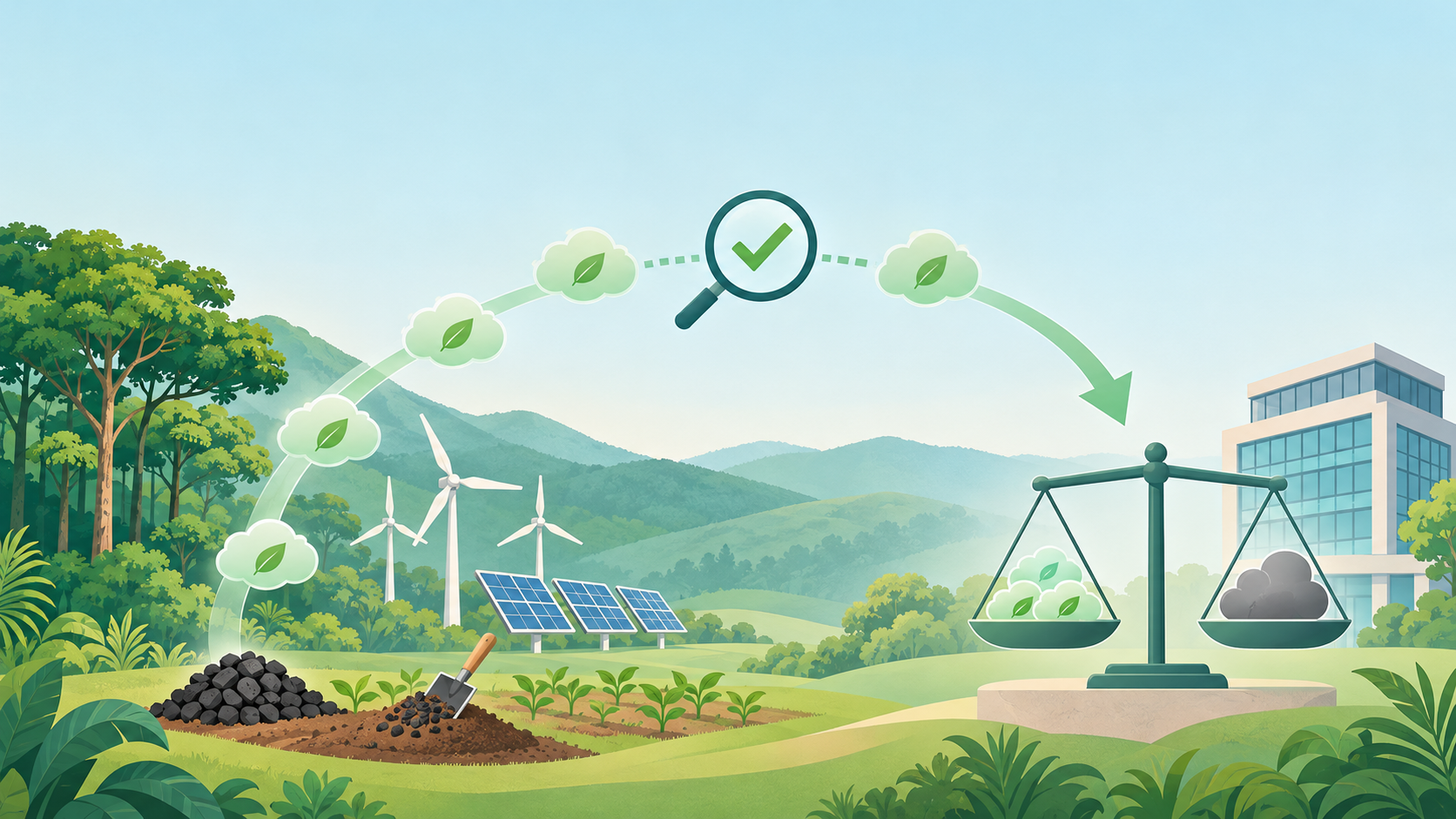
  • What are Carbon Credits? A Simple Guide to Their Mechanism, Types, and Precautions for Use

    What are Carbon Credits? A Simple Guide to Their Mechanism, Types, and Precautions for Use

    Many companies are working to reduce greenhouse gas emissions to achieve a decarbonized society. Carbon credits are a mechanism that makes the amount of emissions reduced or greenhouse gases absorbed by companies and organizations tradable, supporting the achievement of decarbonization targets 1, 2, 3.

    These credits typically correspond to a reduction or absorption of 1 ton of carbon dioxide emissions 1, 2. Even if a company finds it difficult to reduce its own emissions, purchasing carbon credits allows it to offset those emissions 1, 2.

    This article provides a clear explanation of carbon credits, from their basic mechanism to types and important points to consider when using them.

    Basic Mechanism of Carbon Credits

    Carbon credits are a certification of the amount of greenhouse gases reduced or absorbed by companies and organizations through activities like forest protection or the introduction of energy-saving equipment, made tradable as "credits" 1, 2, 3. This certifies greenhouse gas (GHG) emission reductions or absorptions, in terms of 1 ton of CO2 equivalent per credit, making them tradable 1, 2, 3.

    One carbon credit typically corresponds to a reduction or absorption of 1 ton of CO2 emissions 1, 2. This mechanism allows companies that struggle to meet their greenhouse gas reduction targets to purchase amounts reduced by other companies, thereby offsetting their own emissions 1, 2. This helps companies achieve their emission targets 1, 2.

    Types of Carbon Credit Markets: Compliance and Voluntary Credits

    Carbon credits are broadly divided into two types based on their operating body: "compliance credits" led by the UN or governments, and "voluntary credits" led by private organizations 4, 3, 5, 6. This distinction also relates to their usage and market characteristics 4, 3.

    In Japan, a representative example of compliance credits is "J-Credits" 4. These are operated under the leadership of the Japanese government and local public bodies 4.

    On the other hand, voluntary credits are certified and issued by private companies, NGOs, and similar entities 5, 6, 7. A key feature is their flexibility in use, as they are not bound by national or regional regulations 5, 6, 7.

    International voluntary credit certification schemes include VCS (Verified Carbon Standard) and Gold Standard 5, 6, 7.

    Types of Carbon Credits: Reduction/Avoidance and Removal/Absorption

    Carbon credits are categorized into two types: "avoidance/reduction credits" which prevent future emissions, and "removal/absorption credits" which directly capture CO2 from the atmosphere 8, 4, 2.

    Avoidance/reduction credits are generated from activities that reduce greenhouse gas emissions, such as the introduction of renewable energy or energy efficiency improvements 4, 2.

    Removal/absorption credits are created through activities that physically remove CO2 from the atmosphere, such as afforestation and forest management, biochar, and Direct Air Capture and Carbon Storage (DACCS) 8, 4, 2, 9.

    Under the SBTi (Science Based Targets initiative) Net-Zero Standard, only removal credits are accepted for offsetting residual emissions in achieving the final 2050 target 4.

    Trends and Market of Carbon Credits in Japan

    In Japan, there is a national certification system called the "J-Credit Scheme," which targets greenhouse gas reductions and absorptions from energy saving, renewable energy, and forest management 10, 11, 12. Under this scheme, applications for certification of CO2 absorption by forests through forest management activities and afforestation activities are possible 10, 13.

    The domestic carbon credit market in Japan opened at the Tokyo Stock Exchange in October 2023, with trading of J-Credits beginning 10, 4.

    Furthermore, partial mandatory implementation of the Domestic Emission Trading Scheme (GX-ETS) is scheduled to start in April 2026, where J-Credits and JCM will be available as offsetting tools 2.

    Significance of Carbon Credit Utilization and Precautions for Use

    Carbon credits are drawing attention as an economic tool for achieving carbon neutrality 1. Those who generate them can use the proceeds from sales to invest in further emission reductions 3.

    When companies use them, it is crucial to first thoroughly reduce their own emissions and then position carbon credits as a means to supplement any remaining unavoidable emissions 4.

    If the quality of credits is low, companies face the risk of being criticized for "greenwashing" (superficial environmental consideration) 4. Additionally, "double counting" is another issue in their use 4. This refers to cases where credits are issued multiple times from a single reduction activity, the same credit is used multiple times, or the same reduction amount is claimed for achieving multiple targets 14.

    To choose high-quality credits, it is recommended to check the following criteria:

    • Additionality
    • Permanence
    • Prevention of double counting
    • Reliability of Measurement, Reporting, and Verification (MRV)

    Conclusion

    Carbon credits are an effective means to achieve a decarbonized society, but it is crucial to understand their mechanisms and types, assess their quality, and use them appropriately. By selecting reliable credits, companies can avoid the risk of being criticized for "greenwashing"—promoting environmental consideration without substance—and contribute to effective decarbonization management 15.

    Our company is interested not only in the utilization of carbon credits but also in environmental conservation activities in the regions where they are created. Please feel free to consult us if you have any challenges with decarbonization management.

    Sources

    1. jogmec.go.jp
    2. rm-navi.com
    3. ricoh.co.jp
    4. invox.jp
    5. bluedotgreen.co.jp
    6. hello-green.jp
    7. shizen-hatch.net
    8. pps-net.org
    9. marubeni.co.jp
    10. maff.go.jp
    11. japancredit.go.jp
    12. wikipedia.org
    13. jafta.or.jp
    14. pps-net.org
    15. bluedotgreen.co.jp